
On Saturday, May 30th, at 4:04 PM Pacific Standard Time, I finished the final revision of a manuscript I have been writing and (mostly) editing for over three years. The moment after I compiled (exported) it from Scrivener, it hit me dead-center in my chest. It’s done.
I stepped back from my standing desk and just sat on the floor right there and cried. I was happy; of course. But mostly it was a release.
“And then I’m free?”
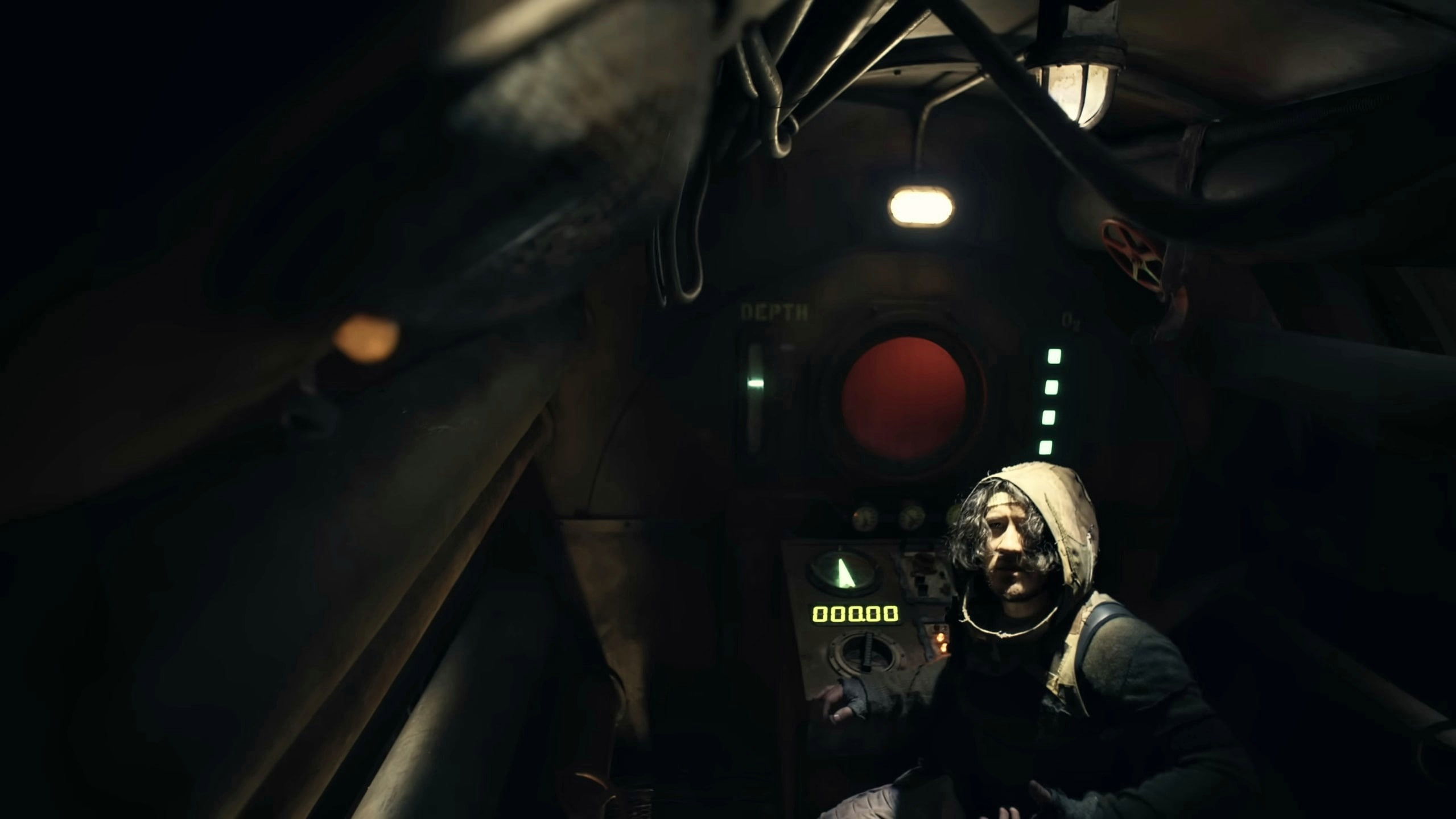
I celebrated by ordering dinner, pouring a glass of wine, and watching IRON LUNG on YouTube Movies. I had seen it before, as you may know from my previous post. I was excited to watch it again now that my mind was free to set aside my own story for a while to go on an… expedition, er um, y’know.
And if you DON’T know, then you should STOP NOW.
Go watch IRON LUNG first, because there will be spoilers. “It’s worth it.”
Deal? Deal.
H’okay, so. I have a degrees in English Literature and Film Production. I love the art of storytelling in every medium, video games included.
This film analysis of IRON LUNG explores the complex narrative structures, nuances character development, deeply layered symbolism, and my own theory on what happens with Simon at the end of the film.
“Beginning the descent.“
MEETING THE CONVICT.
As you undoubtedly know, IRON LUNG, is based on the video game by developer, David Szymanski. Markiplier was committed to preserving that experience in the film. As such, it created a unique challenge of introducing and developing a character in an almost entirely solitary environment with little interactions for us to get to know him through.
I’ll use timestamps to the digital release (linked above) to reference key moments, rather than using a bunch of images. This post is already long and I still can’t fully cover all the layers of complexity Markiplier packed into this film.
At 2:03 into the film, we see a close up of The Convict’s wrist: bruising from handcuffs, the tie with a metal link pried open (something missing), and his thumb gently rubbing a leather, empty sheath. I could say more about his character introduction but let’s keep this Hemorover moving.
THE SHEATH
The sheath being one of the first things we see The Convict use as a source of comfort is brilliant. We learn later that his mother gave it to him before apparently giving him to the Eden cult. He reaches for it instinctually, such as after the “hull breach” moment at 53:11. The sheath is deeply important to him all that way to the end of the film.
And what is a sheath, if not something to protect a weapon?
This little piece of leather is a mother’s love, a mother’s protection in her absence, and a thing to hold a weapon; like the weapon he became.
“Butcher.”

(Go to 1:25:48 to see how I felt writing that comparison.)
THE LENS OF FILAMENT STATION
I mentioned the “blood bars” in my previous post on Iron Lung. There is another moment of bars appearing as the reflection of the pipes on the porthole glass at 4:40. Reflections play a huge part in this film. But it’s the glass itself that stuck with me. At 3:33 we hear The Captain tell The Convict:
“You know, we salvaged that glass from Filament Station.”
The Convict’s reaction tells us this has something to do with him. But as a poetic narrative element, the porthole glass being linked to his history is perfection.
The COI personnel, (especially The Captain) literally AND figuratively see him through the lens of Filament Station, his past, his guilt.
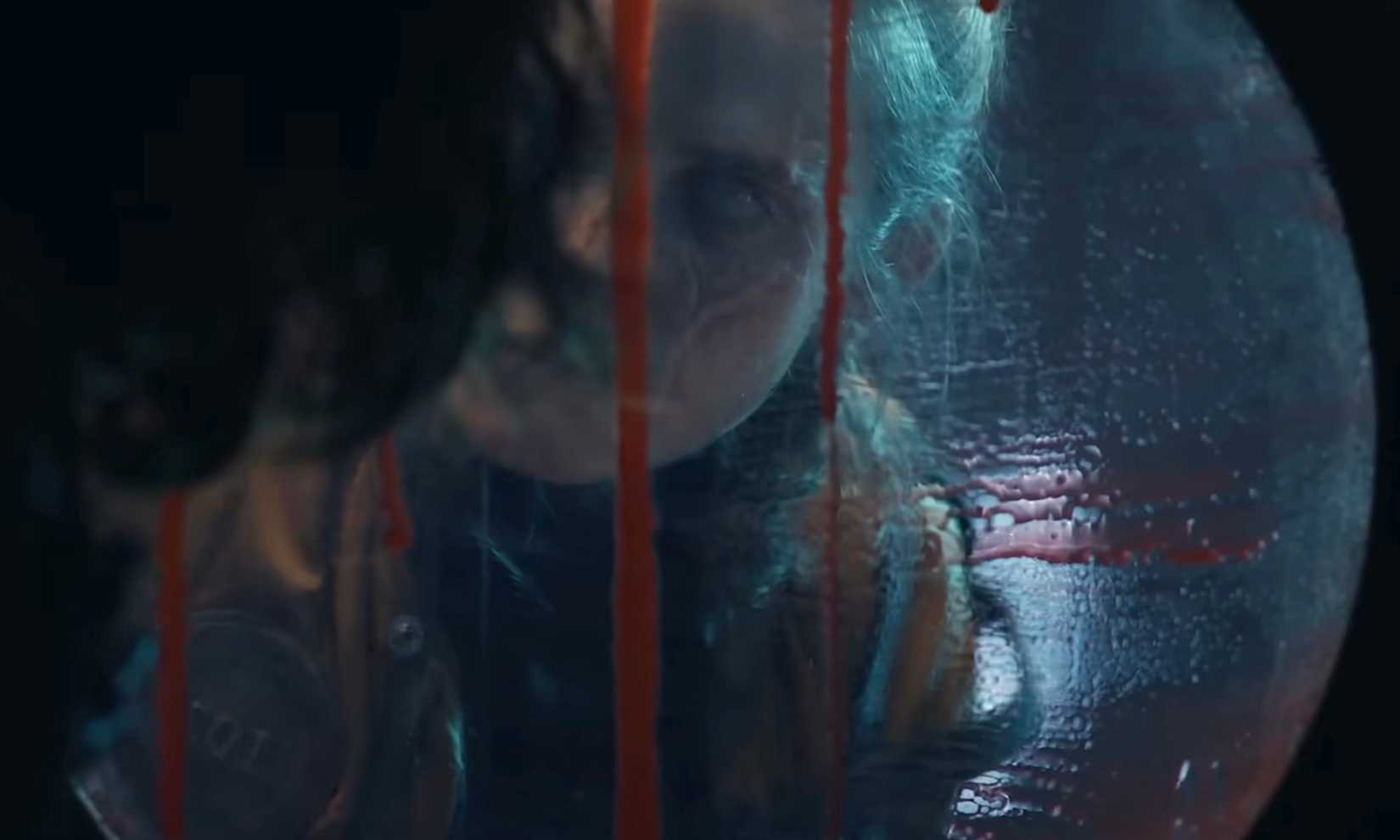
And he, in turn, sees himself reflected back in that guilt and the weight of a history he can’t escape and can’t avoid. It is staring right back at him. The scene at 35:29 to about 37:10 highlights this well, going back and forth between medium close ups of The Convict and rack focusing to his (self)reflection through the lens of (Filament Station) guilt, and his past.

(Side note on, “Game over and you know it.” Nice nod to the game, Mark.)
DOT THE EYES
Another fantastic method of storytelling is the use of reflections in his eyes as a means to convey what is going on in his mind; like at 8:02 with the oxygen meter and the coordinates on the control panel.
If you haven’t noticed it before, watch for the reflections throughout the film. I have so many moments in mind; too many to share here.
A reflection of the skeleton in his eye at 12:18 is paired with it the subtle use of the proximity alarm sounding like a heart rate speeding up with fear. Not only did it tell us something was moving out there, but it conveyed the terror “The Convict” felt at seeing something so close and so unexpected.
As an aside, I think that it is subtly symbolic that everything The Convict has to gauge his surroundings by is some source of light (or lack thereof).
THE LIGHT / MORE THAN MEETS THE EYE
Of course, we can’t talk about a source of light without bringing up 116, 520. The Void. The Light. The image of a giant eye. I think there’s more than meets the Eye.
I love that we don’t learn The Convict’s name until 59:28, nearly an hour in. This is also when the “eel” monster learns his name. Simon, the name, means “he hears,” or, “God has heard.” He hears, but is rarely heard, rarely understood, or listened to. This is important in the context of Simon meeting “eye to eye” with the Void.
1:24:29 —
Void: “I see you.”
Simon: “I see you.”
Void: “Agreed.”

That interaction is extremely interesting. This is where I have a layer of my own interpretation on what happens after this point involving the time loops, time loss, and the ending of the film itself. See, I think the god-like entity was not simply stating the fact that it could see Simon. I’m sure I’m not the only one saying that. It was seeing him, understanding him, but the line “Agreed,” added something more.
I think it was a common consent, a recognition of commonality, as if the entity sees something of itself in Simon, “The Butcher.” When we see a close up of Simon’s eyes as he looks (at 1:25:40) we see Simon’s pupils deepened like little voids of their own. This is a similarity to the “eye” at 1:25:47 staring into him. Then it calls him by a name others gave to him, Butcher.
If you’ll allow me to play with my insanity here, I think the image we see of the god at 1:25:47 has a similar look to the mutation we start to see around Simon’s left eye: the flash of a red iris at 1:51:50, and the mutation after the “blood baptism” at 1:54:31.
I also find it really interesting that the voice (his mother?) warning him (starting at 1:40:50), eventually points out, “On your left.” And every mutation that happens to him, including the arm he loses… is on his left.
When he is back on the SM-13, he still has ‘one’ oxygen left. The Captain tells him it has been days since he lost contact. I think a whole lot more happened when he was pushed into the void at 116, 520. I think Simon took a part of the Light with him. This is what gives him the ability to time-loop (as the “monster” we see in the beginning) as well as explains the missing days before the SM-13 came to life, producing oxygen for him to breathe.
It is this Light that Simon took with him as an agreed commonality with the god that I think sparks from Simon’s left eye at 1:59:08. This was HIS choice.
The “eel” wanted him to transform into a being like itself, or to die and “stay dead” just the COI had wanted, or expected. The Void saw him as The Butcher, like Itself, that caused at least a fragment of the Quiet Rapture and a people only “one in the blood.” Simon only ever just wanted to live. He wanted to know what happened, but mostly he wanted to go home. Yet, he still clung to the hope of the Last Tree and what he learned on Eden.
So, in the end, he chose to become the blood tree, (or, The Last Tree that lives again). I believe the flashes of light around the eel monster as the tree bursts out and kills it come from Simon. It is his spark of life, his will to live, and his desire to return to The Grove that rejects the monstrous mutations his severely irradiated body is going through. Instead, he becomes a symbol of LIFE and not a weapon of death.
CROSS THE WIRES
I want to point out two final things as I wrap up. Markiplier masterfully matched the narrative structure of the film to the gameplay experience. And the “Cross the Wires” means SO MUCH more than a note suggests.
The video game-style narrative IRON LUNG follows was done beautifully subtle and perfect as an adaptation. If we think of Simon as the video game character, the time loops fit as if loading from a previous save point. Simon learns early on how to close the porthole shield and where the black box is because he needs to know these things later in time sensitive situations.
The next time you watch IRON LUNG (because you better have watched it before reading this — “We had a deal!”), watch for all the imagery of crossed wires, or X’s with the tape (like the match cut at 59:32-35), or the X part of the Eden symbol growing over the camera button at 1:50:17). There’s an X over the ‘closed’ on the KEEP CLOSED placard at 1:58:26.
It’s all over the film visually, but also in the story itself. When Simon was able to activate the camera (the “radiation gun”), David says: “That w– That shouldn’t have happened.”
He explains that he must have wired it into the backup battery. The wires were crossed. His words nearly match Simon’s, “That wasn’t supposed to happen!” Like maybe a crossed wire had something to do with Filament Station? Any misunderstandings between Simon and the COI; crossed wires. It is a brilliant, recurring theme throughout the entire film.
I could say so much more. Maybe I’m right. Maybe I’m wrong.
Maybe I have my wires crossed.
But in the end, all I have left to say is, Markiplier, I see you.
And I can’t wait to see more.